




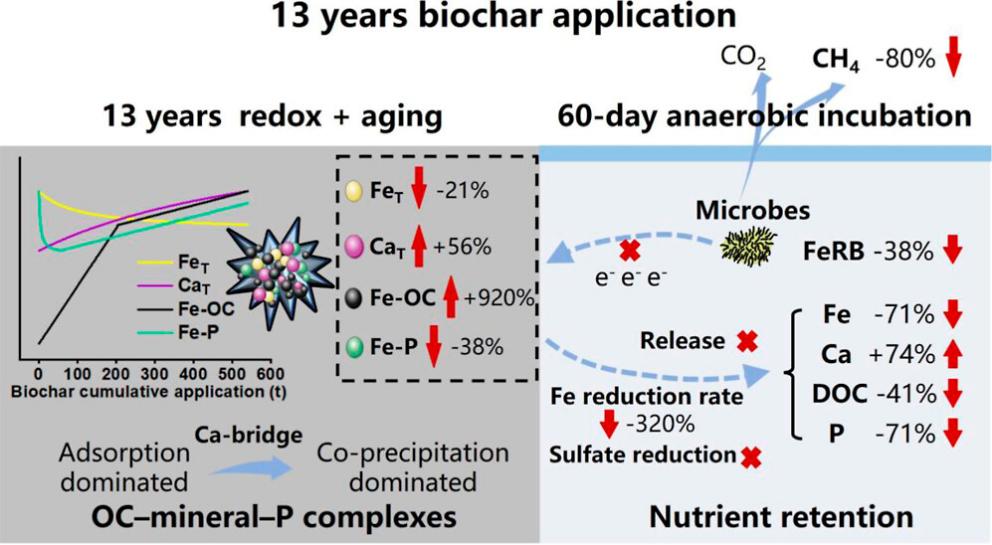
Biochar is increasingly promoted as a climate-smart amendment, yet its long-term effects on nutrient retention and greenhouse gas emissions in flooded rice systems remain poorly resolved. Here, we combine a 13 year field trial with graded straw biochar applications (0–22.5 t ha–1 season–1) and a 60 day anaerobic incubation of year-13 soils to investigate how mineral and microbial processes regulate soil organic carbon (SOC), phosphorus (P), and methane (CH4) dynamics. Long-term biochar progressively depleted Fe oxides and enriched Ca phases, promoting the formation of Ca-bridged OC-mineral-P complexes that costabilize OC and P. Under prolonged anoxia, soils amended with high rates of biochar exhibited 2.5–3.2-fold slower Fe(III) reduction and delayed sulfate reduction, resulting in 53–80% lower CH4 emissions and 60–71% P release relative to the no-biochar control. Nanoscale imaging and microbial profiling corroborated this mineral transition, showing a shift toward redox-resilient organo-mineral complexes and microbial communities associated with suppressed methanogenesis and enhanced nutrient retention. These findings provide long-term field-based evidence that biochar can simultaneously sustain crop productivity, enhance C and P retention, and mitigate CH4 emissions in flooded rice agroecosystems. Our findings highlight biochar’s potential as a scalable nature-based strategy for integrating nutrient management with climate mitigation in global rice production.
This study published inEnvironmental Science & Technology in February.
Attachment Download: