




Water-saving irrigation techniques, such as intermittent irrigation, are essential for sustainable rice cultivation amid growing freshwater shortages. However, periodic drainage creates aerobic soil conditions that drastically boost cadmium (Cd) bioavailability, leading to severe grain Cd enrichment. Disentangling the antagonism between water conservation and low grain Cd remains a critical challenge for rice breeders and soil scientists worldwide.
A new study led by Profs. SHEN Renfang and ZHU Xiaofang from the Institute of Soil Science, Chinese Academy of Sciences, has identified a conserved molecular cascade that explains this phenomenon. Published online in Current Biology on July 8, the study demonstrates that drought and abscisic acid (ABA) signaling actively trigger excessive Cd uptake in rice under water-saving regimes.
Using CRISPR-Cas9 mutant screening, biochemical assays, and multi-location field trials, the team identified the transcription factor OsNAC4 as a key regulator of grain Cd accumulation. Phenotypic assays across multiple genetic backgrounds validated that the functional knockout of OsNAC4 reduces grain Cd concentrations by 30%–50% under intermittent irrigation, without any negative impacts on grain yield or key agronomic traits.
Mechanistically, the researchers established the OsSAPK2-OsNAC4-OsNRAMP1 regulatory pathway. Under aerobic or drought conditions, activated endogenous ABA signaling stimulates the SnRK2-type kinase OsSAPK2. OsSAPK2 physically interacts with and phosphorylates OsNAC4 at four conserved serine residues, stabilizing the protein and enhancing its DNA-binding affinity to upregulate OsNRAMP1—a major plasma membrane transporter mediating root Cd uptake. This stress-inducible switch forms the molecular basis of the “aerobic penalty” of elevated grain Cd.
Importantly, the osnac4 knockout exclusively suppresses stress-triggered excess Cd uptake while preserving the basal transport of essential metals like manganese and iron required for normal development. In contrast, direct mutations of OsNRAMP family transporters often disrupt nutrient homeostasis and cause severe growth defects.
“Our work demonstrates that elevated grain Cd under drainage is not merely a passive consequence of soil redox shifts; rather, plants actively amplify Cd absorption via endogenous ABA signaling cascades in response to aerobic environments,” said Prof. ZHU, one of the lead authors.
By characterizing the OsSAPK2-OsNAC4-OsNRAMP1 pathway, this study provides a precise theoretical framework to decouple water stress signaling from heavy metal accumulation, offering an effective breeding target to develop climate-resilient, low-Cd rice varieties compatible with water-limited agriculture.
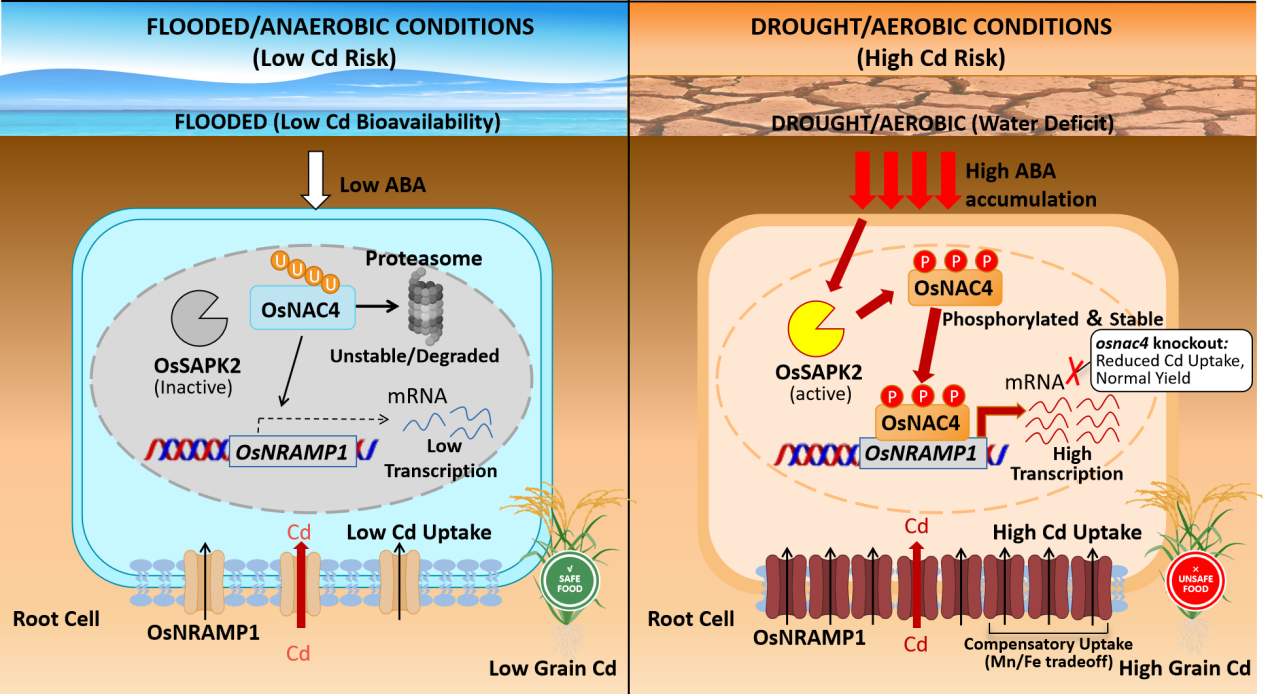
A proposed working model illustrating how ABA signaling links water status to Cd accumulation via theOsSAPK2-OsNAC4-OsNRAMP1 module in rice. (Image by SHEN Renfang’s team)
Attachment Download: